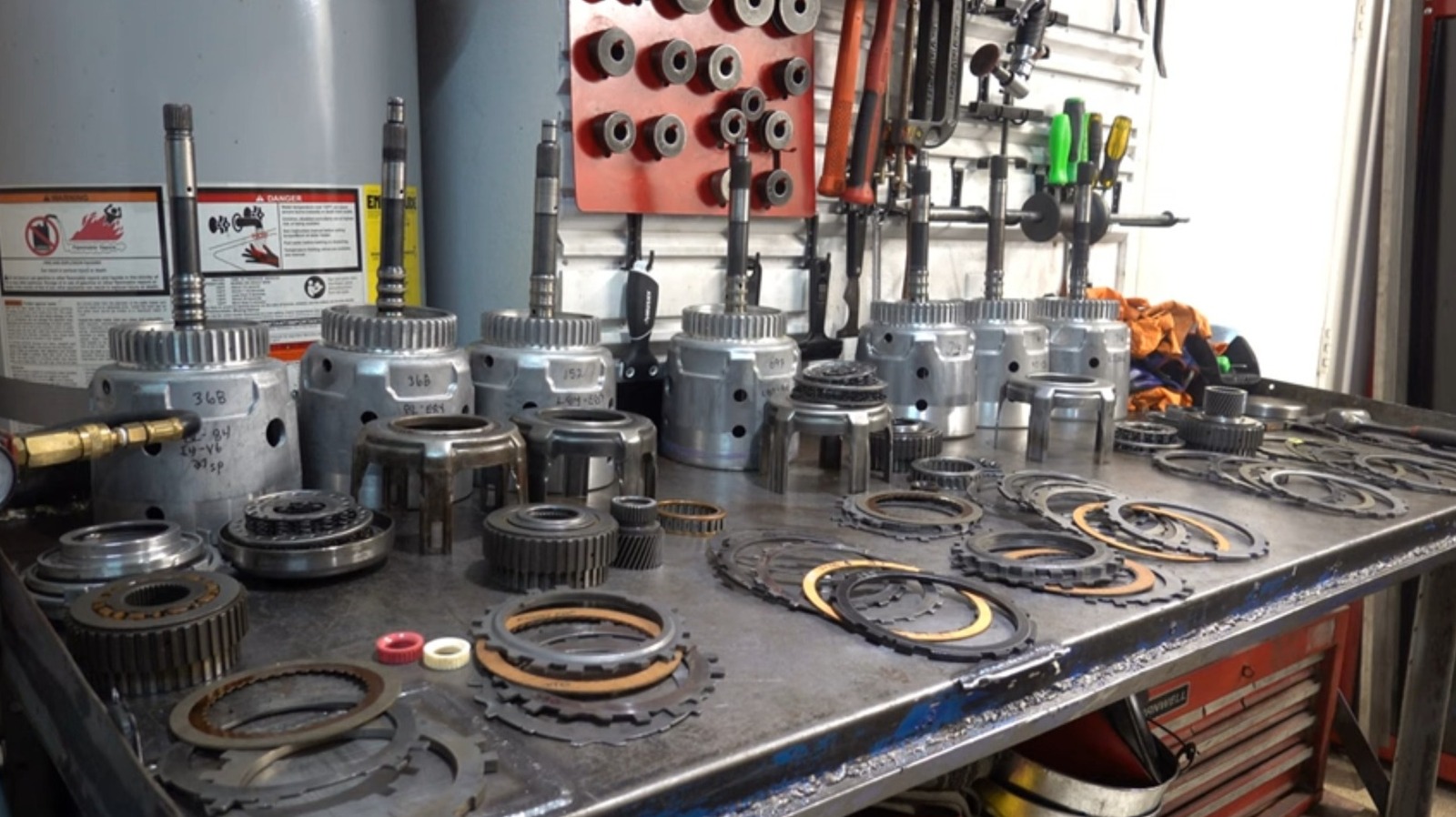
For the modern Tesla owner, the inner workings of a traditional automatic transmission might seem like a relic from a bygone era. Yet, as the electric vehicle revolution accelerates, a fascinating secondary market has emerged: classic car electrification. Under the hoods of many restomod projects, you'll often find the remnants of internal combustion history, including two legendary GM transmissions: the 700R4 and its successor, the 4L60E. Understanding their key differences isn't just gearhead trivia; it's crucial knowledge for anyone considering an EV conversion where these units may be repurposed or removed entirely.
The 700R4: The Hydraulic Workhorse
Introduced in 1982, the 700R4 (later renamed the 4L60) was General Motors' four-speed overdrive answer to the fuel crises of the era. Its design is purely hydraulic and mechanical. The transmission relies on a complex network of throttle valves, vacuum modulators, and governor pressure to determine shift points and firmness. This means its behavior is directly tied to engine vacuum and throttle cable position. For converters, identifying a 700R4 often comes down to the mechanical speedometer cable port and the presence of a throttle valve (TV) cable—a critical linkage that, if improperly adjusted, can lead to rapid transmission failure. Its robust, analog nature makes it a simple but demanding companion.
The 4L60E: The Electronic Evolution
The 4L60E, entering production in 1993, represents the digital leap. The "E" stands for electronically controlled, marking its most significant divergence from the 700R4. GM replaced the hydraulic throttle valve system with a Transmission Control Module (TCM) and a suite of sensors. Shift points, torque converter lockup, and line pressure are now managed by a computer receiving inputs from engine sensors. Externally, you'll identify a 4L60E by its electrical connector and an electronic vehicle speed sensor in place of the mechanical cable drive. This electronic intelligence allowed for more adaptive performance and integration with modern engines, but it also added complexity to the control system.
The core distinction boils down to control architecture: cables versus computers. This fundamental difference dictates everything from how the transmission is serviced to how it interacts with a vehicle's brain. In a conversion context, a 700R4 in a donor vehicle can often be retained with aftermarket controllers, but its dependence on engine vacuum becomes irrelevant in an EV. The 4L60E, conversely, can be more seamlessly integrated using specialized EV motor controllers that can simulate the expected sensor signals, though it requires managing its standalone TCM. The choice impacts the complexity, cost, and approach of the entire conversion project.
Implications for Tesla Owners and EV Investors
For the Tesla community, this technical deep dive underscores the accelerating convergence of classic automotive culture and electrification. As more enthusiasts seek to electrify GM-platform vehicles, understanding these transmission legacies is key to deconstructing donor cars and sourcing compatible parts. For investors, the vibrant aftermarket supporting these transmissions—from stand-alone controllers to adapter kits—highlights a growing and sophisticated niche within the broader EV ecosystem. It's a tangible reminder that the future of transportation isn't just about new vehicles; it's about transforming our mechanical past with digital, electric intelligence, one iconic transmission at a time.