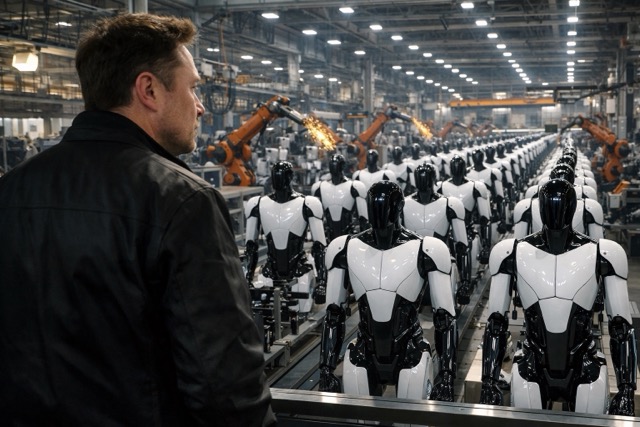
In a move signaling a critical acceleration of its most ambitious project, Tesla is poised to begin large-scale training of its Optimus humanoid robots at Gigafactory Texas as soon as next month. According to a new report, this strategic expansion beyond its California development labs marks a pivotal transition from prototype refinement to real-world, in-house validation. The deployment of Optimus within one of Tesla's most advanced manufacturing hubs isn't just a test—it's the first major step toward proving the robot's economic thesis on the factory floor itself.
From Lab to Line: The Texas Training Ground
For over a year, Tesla's Optimus team has focused on core development and AI training in controlled California environments. The shift to Gigafactory Texas represents a quantum leap in complexity and ambition. Here, Optimus units will be exposed to the authentic, unstructured chaos of a live manufacturing setting. The initial focus, as inferred from Tesla's previous demonstrations, will likely involve repetitive logistical tasks such as moving parts, packaging batteries, or tending to assembly line cells. This "learn by doing" approach in a functional gigafactory provides irreplaceable data, challenging the robots' perception, navigation, and task execution in ways a simulation cannot.
The Data Engine Meets Physical Labor
This expansion is fundamentally about scaling Tesla's most potent asset: its data engine. Every stumble, success, and unexpected scenario encountered by Optimus in Texas will feed a vast neural network, accelerating its learning curve. The company's end-to-end AI architecture, which powers its Full Self-Driving software, is being adapted to teach the robot human-like dexterity and reasoning. Training inside a facility that produces the Cybertruck and Model Y is a deliberate strategy; success could eventually see Optimus robots performing tasks deemed dangerous, repetitive, or undesirable for human workers, addressing chronic labor shortages and aiming to drive down unit economics.
The implications for Tesla's operational and financial model are profound. If Optimus can reliably automate even a narrow set of manufacturing or logistics functions, it could lead to significant long-term cost reductions and production efficiency gains. More immediately, this move applies intense internal pressure on the Optimus program to deliver tangible value, shifting the narrative from futuristic spectacle to practical tool. It also strategically leverages Tesla's existing capital infrastructure—the gigafactory itself—as the ultimate proving ground, avoiding the need to build a separate, sterile testing facility.
For Tesla owners and investors, this development is a clear signal that Optimus is being prioritized as a serious product line, not a side project. A successful Texas pilot would validate Elon Musk's vision of Optimus eventually surpassing the company's electric vehicle business in scale. While widespread commercial deployment remains years away, progress in Texas de-risks the initiative and could become a new pillar for Tesla's valuation. Investors should watch for updates on task completion rates and scalability, as these metrics will soon matter more than the carefully choreographed video demonstrations of the past.