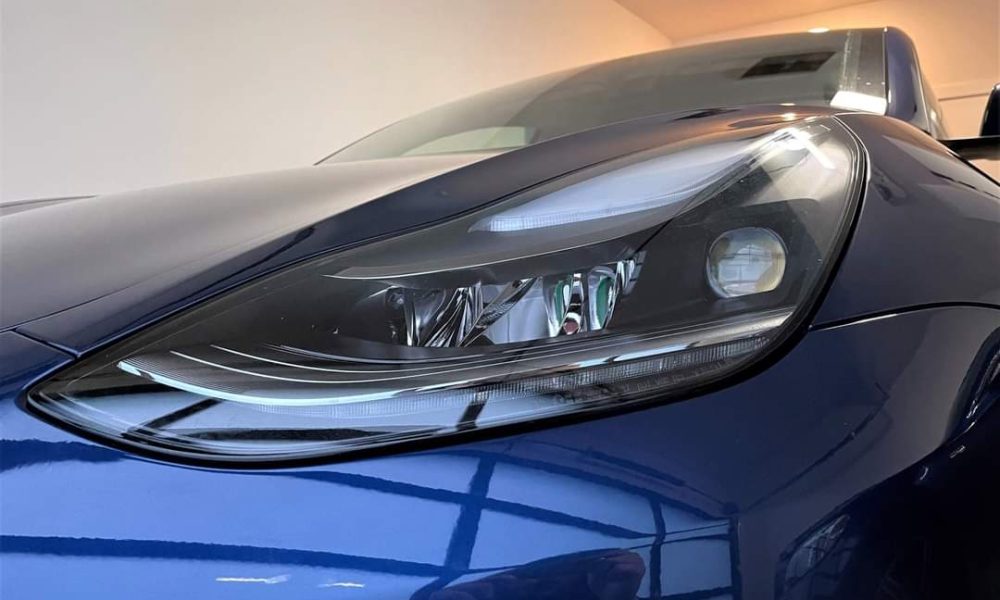
Tesla's relentless pursuit of software-defined vehicle improvement is turning its attention to a critical piece of hardware: the headlight. Fresh code discoveries indicate the automaker is preparing a significant upgrade to its advanced Matrix LED headlight system, moving beyond basic adaptive functions toward more nuanced, intelligent control. This evolution promises to enhance both safety and convenience, transforming a regulatory requirement into a dynamic, AI-powered tool for nighttime driving.
Beyond Glare: Smarter Reactions to Reflective Surfaces
The core of the impending update focuses on a common and often irritating issue for drivers of any vehicle: blinding glare from reflective surfaces. Tesla's software engineers are specifically tuning the system to better handle encounters with highly reflective objects like road signs, traffic signs, and street lights. Currently, the system may react too aggressively or not ideally to these static objects, causing unnecessary dimming or distracting flashes. The refined logic aims to distinguish these scenarios more effectively, ensuring the headlights' adaptive beam provides maximum illumination without compromising the driver's vision or becoming a nuisance.
The Evolution of Pixel-Perfect Dimming
Perhaps the most technically significant upgrade lies in the granularity of control. The current implementation of pixel-level dimming operates in a binary fashion—a specific cluster of LEDs is either fully on or completely off to mask oncoming cars or leading vehicles. The new system introduces a two-stage dimming process. This allows sections of the beam to be partially dimmed, not just blacked out. The result is a smoother, more graduated shadowing effect that can preserve more usable light around the target object, improving overall road visibility while maintaining impeccable glare prevention for other road users.
This advancement underscores Tesla's unique advantage in the EV marketplace: its ability to materially enhance vehicle capability long after purchase through over-the-air updates. Unlike legacy automakers, where a headlight's function is frozen at the factory, Tesla treats hardware as a platform for continuous software refinement. The improved Matrix system is not about selling a new model year feature; it's about retroactively adding value and sophistication to the existing fleet, reinforcing the company's core philosophy of the vehicle as an upgradable asset.
For Tesla owners, particularly those with vehicles equipped with the premium Matrix hardware, this update represents a direct enhancement to daily driving safety and comfort. The more intelligent beam pattern reduces eye strain and potential momentary blindness, a subtle but meaningful quality-of-life improvement. For investors, it's another case study in the power of the software margin and brand loyalty. Each incremental update strengthens the product ecosystem, discourages defection to competitors, and validates the premium attached to Tesla's technology stack, ensuring the car's functionality evolves in a way that traditional automobiles simply cannot match.