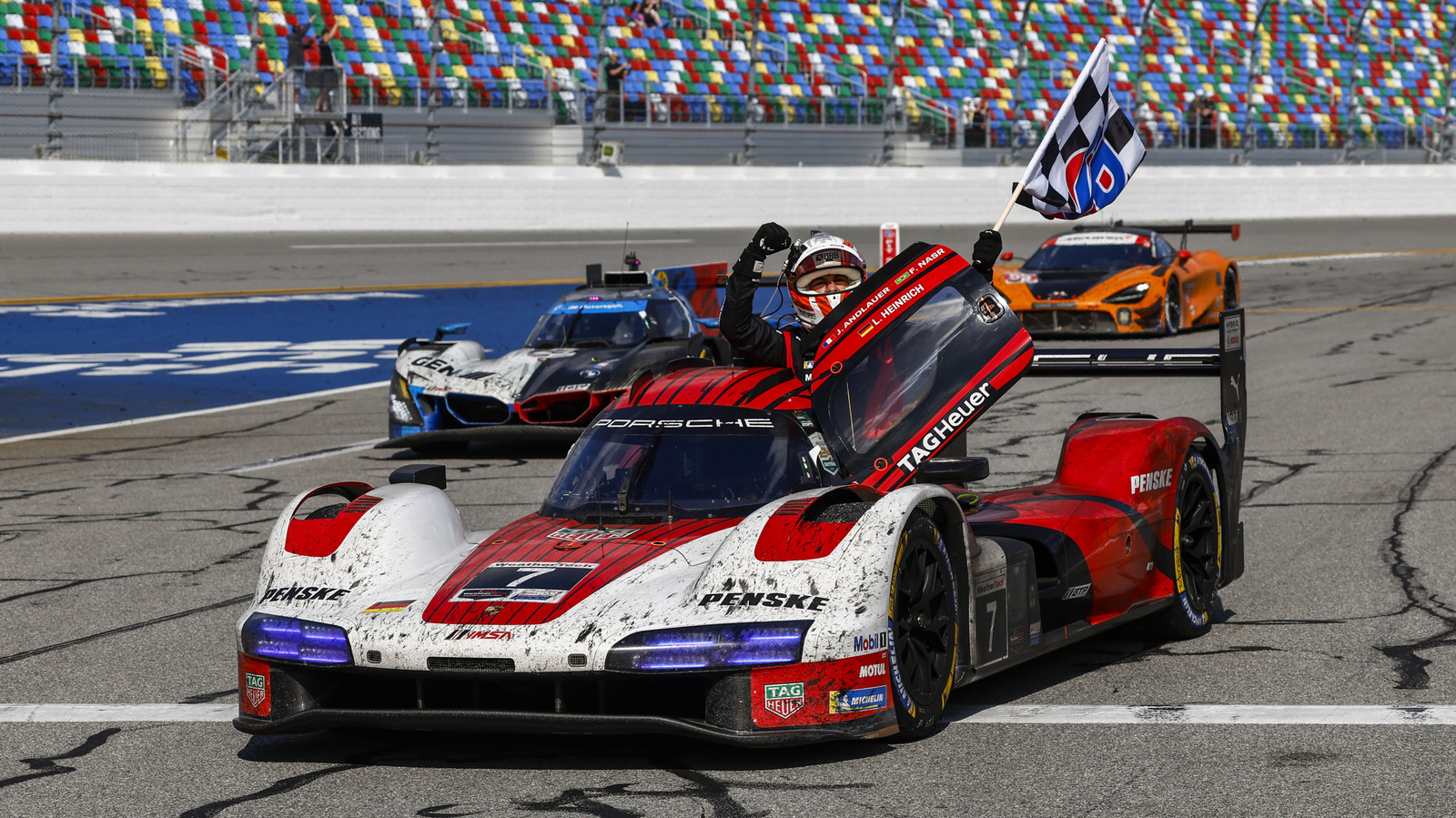
The 2024 Rolex 24 at Daytona will be remembered not just for a victor, but for a surreal battle against the elements that tested the very fabric of endurance racing. In a historic and bizarre conclusion, the Porsche Penske Motorsport team secured its third consecutive win at the iconic event, but only after a mind-numbing six-hour and 33-minute fog delay forced the field to crawl behind the safety car for a record-breaking stretch. This unprecedented interruption turned the grueling race into a war of attrition and strategy, crowning the No. 7 Porsche 963 driven by Felipe Nasr, Dane Cameron, Matt Campbell, and Josef Newgarden in a finish no one could have predicted.
A Race Redefined by Unprecedented Caution
The pivotal moment came in the early hours of Sunday morning, as a dense fog bank descended on Daytona International Speedway, reducing visibility to near zero and making high-speed competition impossibly dangerous. Race control had no choice but to deploy the safety car, beginning a caution period of staggering length. The field spent an astonishing 250 laps circulating at reduced speed, shattering the event's previous record for the longest caution. This extraordinary pause transformed the race from a flat-out sprint into a high-stakes chess match, where preserving the car and managing driver stamina became as critical as outright pace.
Porsche Penske's Masterclass in Composure
In this environment of suspended animation, the Porsche Penske squad demonstrated why it is a powerhouse of modern sports car racing. While competitors grappled with the mental fatigue of the delay and the pressure of a looming sprint finish, the team executed flawlessly. Their Porsche 963 hybrid prototype remained reliable, and their driver lineup—a blend of seasoned sports car veterans and IndyCar star Josef Newgarden—stayed sharp. When the green flag finally flew with just over four hours remaining, the No. 7 car was in a prime position to attack, managing the restart perfectly and controlling the race to the checkered flag.
This victory is a monumental testament to the program's depth. Achieving a three-peat in any major endurance race is a rare feat, but doing so under such distorted circumstances highlights a world-class operational discipline. It also serves as a powerful validation for Porsche's LMDh platform and its strategic partnership with Team Penske, proving their combined ability to win under any conditions, whether traditional or utterly unprecedented.
For Tesla owners and investors, this race offers a compelling parallel in the relentless march of electrification. The winning Porsche 963 is a hybrid, leveraging electric power for acceleration and energy recovery—a core principle familiar to any EV driver. The efficiency and instant torque of its hybrid system were crucial during the countless restarts after the long caution. As motorsport continues to serve as a crucible for road-relevant technology, Tesla's leadership in battery and powertrain software remains highly relevant. The industry-wide pivot to high-performance electrification, so clearly showcased at Daytona, underscores the broader market transition that Tesla continues to lead.
The implications are clear: endurance racing is becoming a key proving ground for the complex energy management and software-driven performance that define the next generation of vehicles. Tesla's expertise in these domains is its ace in the hole. While not on the track itself, the company's technological pillars are increasingly central to winning on it. For investors, this reinforces that the core innovations Tesla champions—software, powertrain efficiency, and energy management—are not niche concerns but critical components of future performance, both on the road and in the highest echelons of automotive competition.


