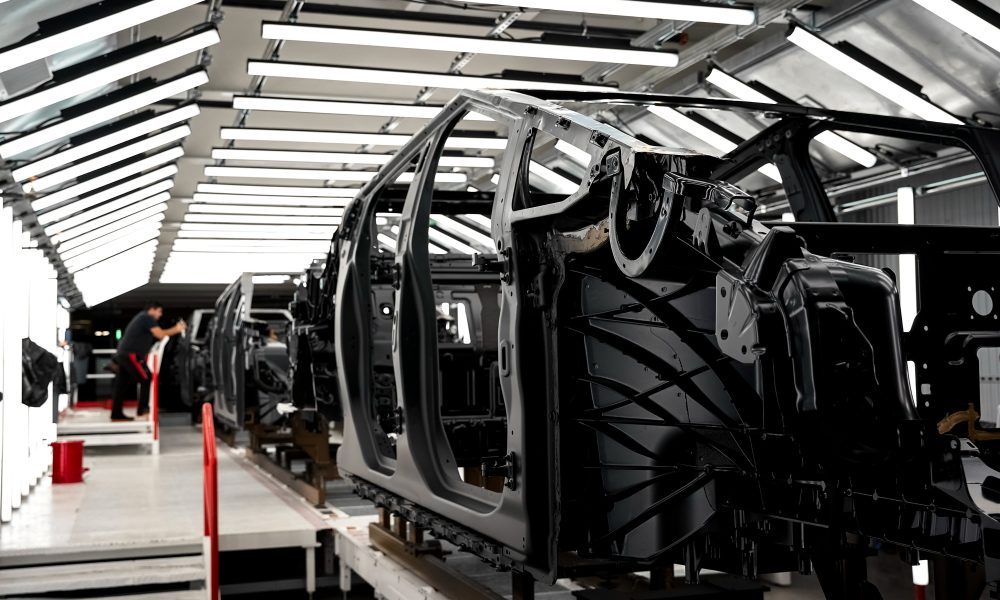
In a move that signals a seismic shift in automotive manufacturing philosophy, legacy giant Ford Motor Company is reportedly integrating two of Tesla's most groundbreaking innovations into its future electric vehicle plans. According to a recent report, Ford's next-generation EVs will adopt Tesla-style gigacastings and the Cybertruck's 48-volt electrical architecture. This strategic pivot is more than mere imitation; it's a powerful validation of Tesla's engineering approach from one of the industry's most storied names, underscoring a fundamental realignment in how cars will be built and powered.
Ford's Gigacasting Gambit: A Nod to Tesla's Manufacturing Revolution
The adoption of gigacasting—a process pioneered by Tesla that uses massive presses to create large, single pieces of a vehicle's underbody—represents a profound change for Ford. This technique moves away from the traditional method of assembling hundreds of stamped and welded components. For Ford, the benefits are clear: radical simplification of production, a significant reduction in factory footprint and robotics, and potential gains in vehicle rigidity and weight savings. While Ford has experience with large castings, committing to Tesla's scale of integration is a bold step toward streamlining their EV manufacturing to improve cost and speed, key factors in the fiercely competitive electric market.
The 48-Volt Standard: Following the Cybertruck's Lead
Perhaps an even more telling adoption is Ford's move to a 48-volt electrical system, a technology championed by Tesla with the Cybertruck after decades of industry reliance on 12-volt systems. This shift is critical for the software-defined vehicle era. A 48V architecture can handle far more electrical load with thinner, lighter wiring harnesses, enabling more powerful onboard computers, advanced features, and faster accessory response. By embracing this standard, Ford is not just upgrading a component; it is future-proofing its vehicles for an age of increased autonomy and connectivity, directly following the path Tesla blazed to enable its advanced digital ecosystem.
This dual-technology embrace reveals a calculated strategy by Ford CEO Jim Farley to accelerate the company's "Ford+" plan. Facing immense pressure to make its EV division profitable, Ford is leveraging proven innovations to leapfrog development hurdles. The context is clear: Tesla's industry-leading margins and manufacturing efficiency, partly enabled by these very technologies, have set a new benchmark. Ford's move is a pragmatic acknowledgment that reinventing the wheel is less effective than adapting a winning formula to scale its own EV ambitions rapidly and competitively.
For Tesla owners and investors, Ford's strategy is a double-edged sword of validation and rising competition. It conclusively proves that Tesla's technological bets on gigacasting and 48V systems are becoming the new industry standards, reinforcing Tesla's role as the de facto innovation leader. This should bolster investor confidence in Tesla's R&D direction. However, it also means the competitive moat provided by these advanced manufacturing techniques will narrow as others catch up. The long-term implication is a market where software, battery technology, and brand experience become even greater differentiators, areas where Tesla continues to hold a formidable lead but will face increasingly sophisticated challengers armed with similar foundational tech.